Tuesday, January 18, 2022

The burden of defying patriarchy

In a patriarchal society one might be aware of the narrative of how daughters are considered a 'burden', a load that family needs to 'unload' soon by marrying her off. But today I am not writing about this, but the mental burden that women shoulder by resisting patriarchy. I explore the burden of being a woman who is brewing a rebellion. As I write, I ask what happens to women who defy patriarchy and why some women do not resist patriarchy but instead perpetuate it consciously or subconsciously.

Patriarchy imposes control on women in families in many different ways. The 'value education' of patriarchy plays a key role in that control. This 'value education' is passed down by family, schools, neighbours, movies, etc. A key lesson this value education inculcates early on is that daughters are meant to listen and agree with the elders so they are more conforming, and submissive. They are meant to 'adjust', 'adapt' and 'fit-in' to the family, and the society. This ensures that patriarchy conditions women and men in the family to learn early on that women are not expected to have an opinion that is at odds with the male head of the family. This value education also dictates how women are meant to keep the 'honor' of the family by dressing in a particular way, by not exploring her sexuality and not indulging in sex before marriage, or finding a partner from the same caste, class and religion. The poster child of patriarchy is a woman who is obedient, submissive, non-opinionated (or not strongly opinionated), adheres to these 'values' with conviction, without questioning, and passes down these 'values' of patriarchy with dedication.  

This value education is also passed down through movies, and the household conversations about what happened to the neighbour's daughter or the relative's daughter. We all know about those conversations that demean that relative's or neighbour's daughter whose character is in question because she is defying these 'values'. So, women in the family who listen to these conversation learn at a very young age that defying these values means 'you are an outcast, a person whose character is in question'. So, this makes sure that women are trained early on to be within these boundaries. Through this 'value education', patriarchy invokes 'fear', another key aspect that plays a role in imposing control on women. The fear of not being loved, not being respected, and becoming an outcast, or a person whose character is questioned, and shamed all become means to impose control.  

Image for representation only. Photo source: You tube.

So, what happens to women who defy these, women who break free from these so called 'values' set by patriarchy? Changing the status quo takes a big toll on women emotionally. Women who resist face the wrath from their own family, risk being not loved, not accepted, which we all seek as human beings. Women who defy these values, and decide to fight the patriarchal control for example, choosing what they want to wear, or exploring their sexuality etc., often have to fight the conditioning. But, does the conditioning ever go away? 

Women who rebel patriarchy can also experience poor self-concept, and self-love, because we are all conditioned early on that defying these values means that you are not conforming to the set boundaries and are being 'disrespectful' to your elders. While defying these values of patriarchy takes toll on women, it is also empowering for those involved in this journey of change that requires tremendous support, courage, stamina, and determination.

As girls grow up they start noticing how patriarchy treats sons and daughters differently. The gendered roles become visible and are taught early on. The support from family to achieve certain aspirations vary significantly. Women grow up to realize how much perception of providing an education for women significantly differs from men in the family. Women are given education to increase the prospects of finding a good groom, and for being able to earn for the family, as an additional support or in case a tragedy hits the family. Whereas men in the family receive education since he will go on to become the prime earning member of the family. Women often struggle to justify their need for support from the family for higher education and some don't even aspire because patriarchy does not require you to be aspirational of receiving higher education that might empower you. In fact it becomes a threat to have woman who is fiercely independent. Patriarchy makes education of a daughter an expense whereas education of son an investment. 

Daughters are often raised saying that they are going to be married one day to be a part of another family and take the responsibilities of the husband's family. In a patriarchal society, a daughter who is married off to another family is no longer seen as part of her parents' family and now belongs to husband's family. It starts with the woman taking husband's second name and prioritizing husband's family over her own. Patriarchy pushes families to disown women and 'send her off' to a new family. Patriarchy lets women to be treated like guests in their own house after marriage, while men continue to enjoy the love and affection of being a son. Women become distant from their own family, and are required to be a part of the husband's family with full dedication. And off course it goes without saying that, women who go on to achieve this gracefully receive adoration and love from both her own and her husband's family. All the training of being a 'good girl' so that the saga of patriarchy continues as she moves in with the husbands family. 

Women who defy patriarchy as they grow up and choose to marry only go on to defy patriarchy further in both families, and it puts them into a constant mode of rebellion. Marriage only unfolds other parts of patriarchy that women need to defy. And women who resist, face emotional crisis because they do not necessarily agree with the concept of belonging to a different family after marriage and fight back the patriarchal expectations of being a 'good daughter', 'good wife' and 'good daughter-in law'. These women take up the complex task of defying as well as loving the people who mean to them. Navigating through these emotions in a patriarchal society is tough and some women face all the brunt in their fight for equality. 

Why do women, even who are well read take upon themselves these values of patriarchy with such conviction? This question always lingered in me looking for answers. Recently, I came across an article titled 'Is it possible some women don't want to be free of patriarchy?' in the Hindu published in 2018, and this helped me find some answers to my question. It talks about the sense of 'protection' women perceive they receive staying within the realms of patriarchy. The article quotes, 'To be a free woman is to shrug off the dubious cloak of “protection” that patriarchy offers, which is its unique selling point for many women'. I think this explanation made sense to me, otherwise I really cannot fathom why some women who are well educated and privileged seem to adhere to these 'values' passed down by patriarchy. I also think that patriarchy has more selling points other than the false sense of security. It also lets women maintain 'status', 'power', and 'family wealth' by adhering, and also enjoy the love, and admiration from the head of the family, 'the male' and also other family members by being the poster child of the patriarchy. Defying patriarchy means losing all of these 'benefits', and the struggle for love and acceptance continues for women who defy. The fear of losing these perceived 'benefits' keeps some women within the realms of patriarchy and also perpetuate it to the next generation. The 'protection' of patriarchy and 'adoration' that you receive for being a poster child is too comforting to give up.

What patriarchy continues to perpetuate keeps evolving with society as people continue to fight for equality. For example, the strict gendered roles were an inherent part of patriarchy, but now things seem to change with men and women taking up roles that defy these gendered roles. However the characteristics of a woman who is a poster child of patriarchy continues to be the same. The one who continues to 'adjust' and be 'submissive' to her family, in-laws, society and adhere to the value structures set by patriarchy, and garners all the admiration and adoration. The women who defy carry the burden of changing the society from the shackles of patriarchy, while also struggling with the emotional toll it takes on them. 

While there are several women out there who are making their ends meet and do not have the time and privilege to think or fight back patriarchy, for those of us who do have the privilege, why not reflect, resist, change, and be there for each other. I dedicate this is for women out there who are resisting patriarchy within their own capacity, bearing the emotional toll, and who are yearning for some self-love and love from those around them as they continue their fight for equality.

Wednesday, May 5, 2021

Exploring insect diversity in my backyard

This one is dedicated to all educators and parents out there who are trying their best to educate themselves, their child or student(s) about the environment around them. You may use this blog to understand common critters found in your backyard. I have also provided some tips to kick start your personal journey of discovering the biodiversity around you or to help your kids or students find interesting ways to explore their backyard biodiversity!

*********

By now you would be wondering about what an outdoor educator was upto during the lockdown and travel restrictions and other restriction around social gatherings, etc. Well, I tried my best to adapt to the online mode of teaching and learning. I was fortunate to work from home and adapt to the new normal. You see being an outdoor educator I would always be out there in a forest, or a farm, or field station with bunch of kids exploring the biodiversity, so I never stayed at home long enough to be able to see what was right under my nose. Since I always had an affinity for insects, I enrolled myself for an online course called Bugs 101 on Coursera based on the recommendation of my good friend, a fellow naturalist Chandhu Bandi. I took this course also because I wanted to up-skill and deepen my knowledge on ecology. This course was super exciting, and gave me the inspiration to start exploring the insects in my own backyard. And by the time I was finishing the course, it was the peak of the monsoons, the time when insect life is thriving around us!! 

Chandhu also introduced me to iNaturalist and though I was initially hesitant to try because I assumed that it would be complicated, I downloaded it on my phone and slowly started exploring it. Soon, I was clicking everything around me, mostly insects and I was trying to find what they are called and reading up everything about them.

More than finding out their names, what I really enjoyed was observing the life of these tiny creatures. There is a joy in watching the lifecycle of a moth from the time of mating to laying eggs to its hatching, watching a carpenter bee build its nest, a potter wasp searching for the right mud to build its nest, and many such delightful moments. I am here to share these little wonders in our backyard with all of you. I hope this will help you learn many interesting things about insects and inspire you to enjoy these tiny creatures around you, and also document them!! 

I love clicking pictures, but there are many ways to document your observations like journaling, creating your own field guides for your backyard, story writing and if you have kids around you involve them as well in these activities! Exploring and learning about what is around them will help kids understand what it is like to share space with other creatures and to learn that insects aren't 'scary' or 'disgusting' or 'pest' as they are often portrayed. Also, I tell myself and my students to learn the local names, and not just the english name or scientific name, because not knowing local names is losing out on the local stories from your grandparents, local knowledge, and other possible conversation you could possibly have with local people, or elders in your family. 

So, here I present to you the insect diversity in my backyard. I hope you will find this useful as a resource and serves the purpose of inspiring you to explore the insects in your backyard.

1. Buzzing bees and colourful wasps

When I started observing bees in my backyard, I did not expect to see the diversity that I encountered. Look at the picture here and you will be amazed! 

The three different species of honey bees that I have observed in my backyard; From the right: Asian honey bee, Giant honey bee, Red dwarf honey bee

Observe the yellow thing bulging out from the legs of this asian honey bee. What do you think this is? This is a pollen basket that the bee uses it to collect pollen from the flowers that serves as source of food for the entire colony. When you notice a honey bee with pollen baskets, most probably you are watching a worker bee collecting pollen and worker bees are hard working females who manage the hive, bring food, and protect all the young ones.


Look at this one carefully, what do you think it is? Well, I was surprised to find that it is a bee, and this is one of the interesting bees I have met. This one is called a cuckoo bee, and it lays eggs in the nests of other bees, reminds you of the cuckoo bird, right? Cuckoo bees do not construct their own nests and rely on other bees to raise it young ones. The females of cuckoo bees do not have pollen baskets, since they do not raise their young ones. 

If you thought all the bees build a hive, wait till you see the carpenter bee. Watch the video to know how it makes it nest.


A carpenter bee makes a nest on this dead wood


I observed this carpenter bee chip tiny pieces of wood to make this nest on a dead wood in my backyard. Even a dead wood plays an important role, right? 

Now lets meet the wasps in my backyard and get to know more about them...


Here is a potter wasp putting in a lot of effort to build its nest, finding the right mud that is moist enough for it to roll, and to bring it to the right spot to build it nest, bit by bit. The wasp was scooping tiny balls of mud and taking it to a scooter nearby to build her nest. Looking at her efforts to make a nest for her baby, would we ever think about destroying its nest? I request you to watch this video till the end and it will blow your mind!


This is nest she build with all the hard work for her young ones!

Wasps are famous for being the 'villain' for its sting, but wasps don't sting unless intimidated. Potter wasps are solitary and just need a tiny place in your backyard to make its nest. And in fact wasps are known to feed on other insects like caterpillars etc. which feed on the plants and increase in their population can effect the plant growth, but wasps keep their population in check. It like a natural 'pest control'. I don't like to use the word 'pest' which originated with monoculture, capitalism and has Eurocentric origins  how the creatures are viewed, but I am using it here in the context of the current society. Well, lets keep this topic for discussion for another day, and get back to the wasps.


When I saw her for the first time, I was amazed at that needle like structure protruding from her body. I later learnt she is called crown wasp and the long protruding thing is an ovipositor that she uses to lay eggs on wood boring beetle larvae. So when her young ones hatch inside the beetle larvae, they start feeding on it and that is how a crown wasp ensures her young ones have the necessary food to kick start their journey in this world. So, this is another way in which wasps keep a check on the population of other insects that feed on the plants. 


Look at this tiny little one that you may pass it off as a fly, but this wasp uses cockroach eggs to deposit her eggs inside that, and when her eggs hatch, they feed on the cockroach eggs. If you see her around in your backyard, she is keeping a check on the cockroach population! She goes by the name ensign wasp.


You might have observed these nests that look like tiny bits of paper hanging from the ceiling in your backyard. Well these amazing nests are build by paper wasps. 

Well the major distinction between bees and wasps are that, bees feed their young ones and themselves with pollen and nectar but wasps feed their young ones with insects, they are fierce hunters, however adult wasps may feed on nectar. So, bodies of the bees and wasps are meant to serve this purpose. If you observe closely, bodies of the bees are plump and they have tiny hairs across their body which help the pollen stick to it and makes it easier to carry it, whereas wasps are slender and not hairy like bees. 

One thing I have learnt from bees and wasps is that they are playing a huge role in the ecosystem: bees as important pollinators and wasps as 'predators' who keep a check on the population of other insects. Next time you see them in your backyard, welcome them, use this as a teaching moment for kids and adults around you, talk to your grandparents or elders about these and have an engaging conversation, learn local names from them, and take forward any interesting stories you might hear from them, but please try your best not to evict them from their home, their presence in your backyard is a good sign of biodiversity thriving around you! 

2. The Monsoons and the Vivid Moths

As soon as the monsoons kick in full swing you will start seeing all of a sudden these hairy little caterpillars crawling on your walls, chewing the leaves on the plants, and crawling on the soil, basically you see them almost all around your backyard. Many of these hairy caterpillar go on to become beautiful moths which also play an important role in the ecosystem as pollinators. Moths can be active in the night or in the morning, many are active in the night however and provide an important source of food for creatures active in the night (commonly called nocturnal creatures) like bats, owls, etc. Here are some common moths you will find in your backyard. 


Meet tussock moth caterpillar, with alternating bristles of hair on its back. These hairs are used for its defence and to keep itself safe. 

You will see them, in different shades and sizes through the monsoons!!


This moth is laying her eggs on the underside of a leaf in my backyard. I often look everywhere for insects and find these amazing sights to cherish. This one is called a sandalwood defoliator, since sandalwood is their host plant, but they are also found on other plants, like the one in the picture here where she is laying eggs on a passion plant.


Ooo.. what are these weird looking things. Who could have put these random pieces of twigs together? So, this one is called a bagworm moth. The caterpillar builds this 'bag' around it for protection, and it stays here, moves around everywhere with this bag, when it senses any threat, it retracts into the bag. They make the bag with materials they find around them like twigs, leaves, shells, dried plant matter, etc. . Only the male moths come out of their bag in their adult stage and fly to mate with a female who is wingless and remain in the case. The male mates with the female and she continues to stay in the bag and lay her eggs in that.  


Watch the lily borer moth munching the leaves of the lily plant in our garden.

Lily plants thrive in the monsoons and so does the lily borer moth. I know you might feel a slight pain watching the moths chew all the leaves, but I have noticed that they always grow back, and it doesn't kill the plant and I have learnt not to disturb them, because they can be food for other insects and they will keep them in check!


Kambalihula is Kannada/Kambilipuchi in Tamil. These hairy caterpillars, are something you will find on your walls, compound, and all around your backyard. They are called footman moth.


Here you notice footman moth in its adult stage. For two days I was hooked on to this moth. The first picture shows the mating which I observed during the early afternoon, and by evening she was laying eggs (second image). In the last picture, which I took the next day, you will notice a fur-ball kind of thing and eggs inside it. She covers her eggs with the hair as a protection against animals that might prey on them.


3. I just tricked you... mimicry in everyday life

This is my favourite part, where the creatures around me have tricked me until I stood there and observed carefully to notice that I have been fooled. Introducing some coolest tricksters in my backyard. You might easily find them around you and keep an eye out for them, take a bow and appreciate their trick! 


Look at me closely, what am I? If you thought I was a weaver ant, then I just tricked you. I am a spider, to be precise weaver ant mimicking spider.


To put things in perspective, here is a picture of a weaver ant on the right and the weaver ant mimicking spider on the left, and you know what a good job it has done in mimicking the ant.

Why mimic the weaver ant? Well, weaver ants are avoided by predators because they have a painful bite and 'don't taste good'. So, by mimicking ants they can keep their predators away. Also, by mimicking the ants, they are able to stay close to them, gaining protection from predators. They mimic the odour, the way these ants walk and also wave their legs to mimic the antennas of the ants. 

Now here is a question for you, is spider an insect or not? Well, if you thought that anything that is tiny, crawls on the floor is an insect, then its time to reveal the truth. Well, spiders, earthworms, centipedes, etc. are not insects. Here is a quick criteria to identify something you see is an insect or not:

1. It has six legs.
2. It has wings in the adult stage.
3. The body can be divided into three distinct parts: head, thorax and abdomen.

I chose to describe the ant mimicking spider here since it is trying to mimic an insect. So, technically spiders are not insects!!
 

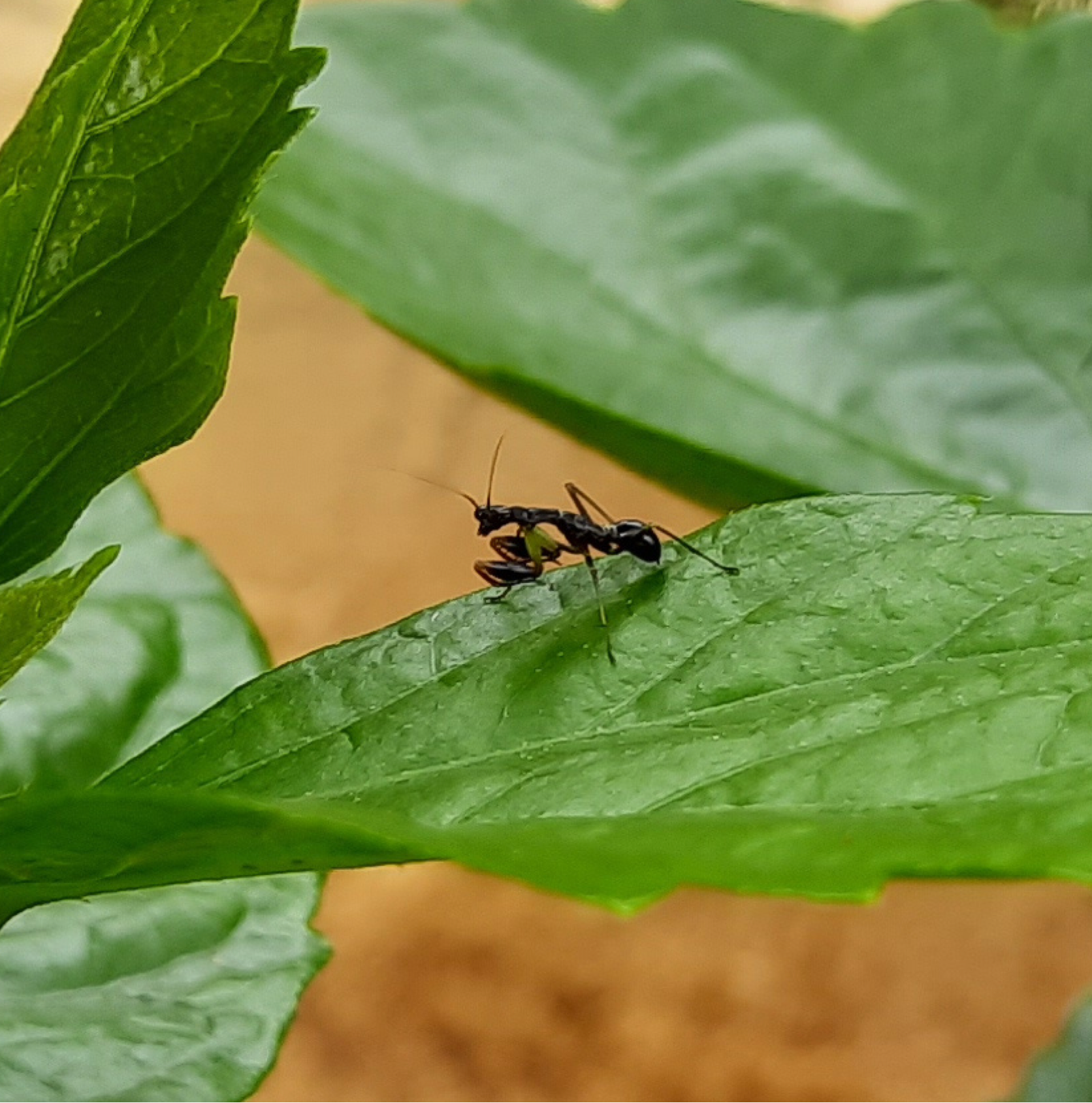
What do you observe here? An ant? Look closer, and you start to notice its something else, but what is it?


Now, you see that its a mantis. This ant mantis does an excellent job in mimicking because there were other ants roaming around in the plant and it took me a while to notice that 'this ant's' forelegs were folded in a peculiar way and then realised that its a mantis and its called asian ant mantis. 

This one mimics ants because by mimicking an ant, predators will avoid them. Seems like this Asian ant mantis are common in urban gardens. They mimic ants until it's ultimate molt when it becomes green in colour. This is because when they are young they are most vulnerable to predators and by mimicking the ants they get protection. As they grow older they start becoming green, as you notice in the picture below, where the mantis is a little bigger and green shades appears on its legs.
 

Asian ant mantis


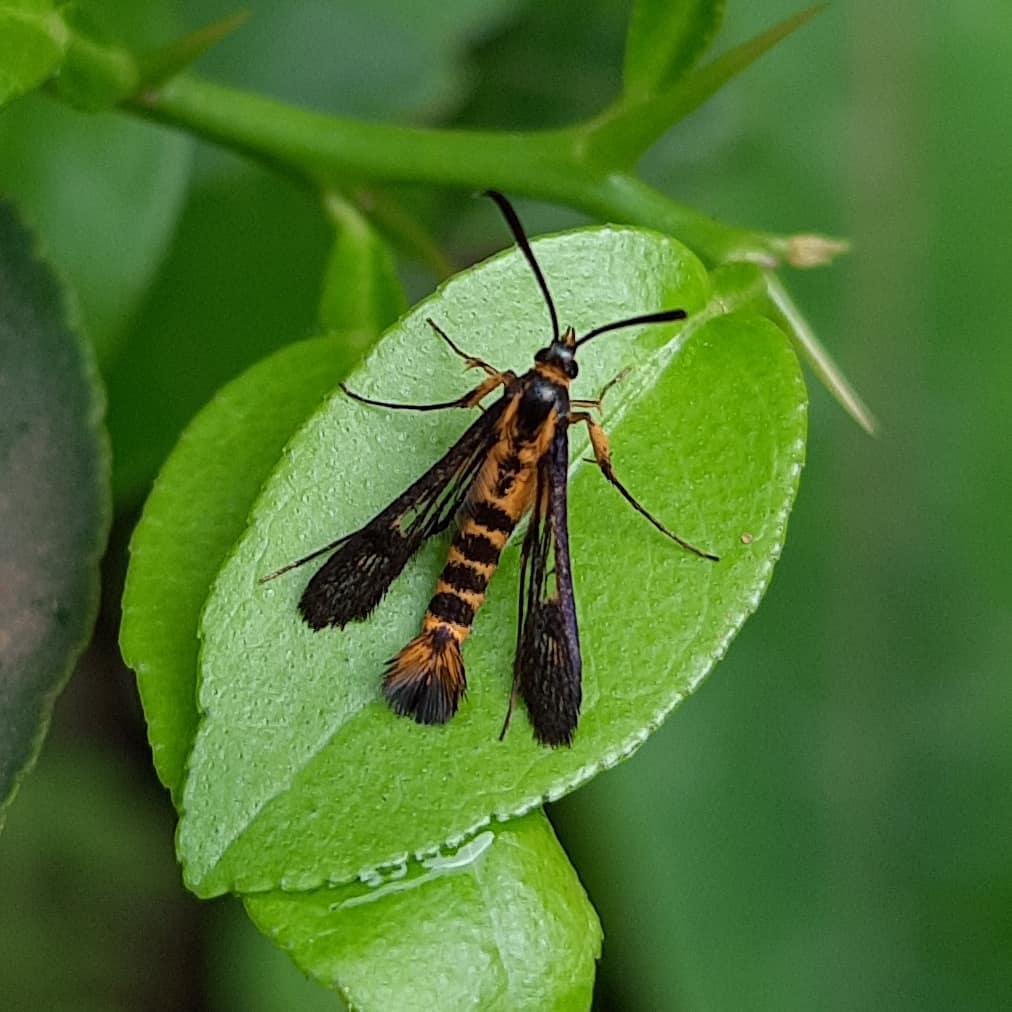
When I looked at it first, I was like ' Is this a wasp or a bee?' and then on closer observation, I could identify it as a moth!! This one is a moth that is mimicking a wasp, hence called wasp moth. But why mimic a wasp? The same reason, wasps are known for their painful stings, and hence predators like birds avoids them, and hence by mimicking a wasp, it gains protection.


There is something really cool about observing creatures that mimic. It shows to what extent they can change their appearance that it ceases to look like its own kind. But a closer observation reveals that it has just tricked you. I could identify that its a wasp moth, by looking at its 'feathery' antennae, and also the waist. 


Now here is a test for you, identify which one is a wasp and which one is a moth. 

Well the one on the left is a wasp and the one of the right is a wasp moth. If you observe keenly you will notice the difference in the waist of a wasp and a moth that is mimicking the wasp.

4. When they make associations with other species...

Whenever I observe insects I feel like like these tiny critters live in a parallel world in the same space where we larger humans inhibit and it is so cool to take a peak into their world.

Here is an interesting insect association that I have noticed in my backyard. There was a plant that had white powdery stuff all over it, and I went closer for observation, and noticed that they are actually tiny insects called mealy bugs. And then I noticed ants hovering around these mealy bugs. I wondered what is going on here.


The white small insects that you see on the plant are called mealy bugs and you can notice the ant in close association with the mealy bugs. Looks like mealy bugs poop sugar rich liquid. This candy poop is something which ants relish. The mealy bug in turn gets protection by ants from other predators. It is so interesting to see one species of insects make association with another species of insects!

I haven't noticed other insect associations in my backyard, and I encourage you to look around and tell me if you find something interesting!!

Exploring and learning about insect diversity in my backyard opened up to me the world of these tiny creatures that are too tiny to be noticed, we are either too scared off, or disgusted by, or too busy to be bothered about them. But these creatures whom we share our backyard with, are an important part of our ecosystem. I can't thank enough for the bees (honey bees, and carpenters bees) that pollinate the flowers and give us amazing passion fruits that we cherish, the wasps that keep other insects in check, and so many insects who give you new things to learn about our environment and appreciate the interconnectedness and interdependencies even in an urban, semi-urban landscapes where we are losing that direct connection to the environment around us. 

Here are a few tips that I can leave you with:

1. Start small, take it slow, observe one species at a time.
2. Download Seek by iNaturalist on your phone to record and identify species around you if you want to do it along with your family, or if you are an educator and want kids to engage with this.
3. Use iNaturalist on your phone if you are an educator yourself or anyone trying to learn, record and identify species around you. 
4. If you are an educator or someone looking to up-skill their knowledge on insect identification, etc. I would recommend enrolling for the course Bugs 101 on coursera.
5. Try and learn about the local names if the insects, as I mentioned, not knowing/learning local names is losing out on the local stories, local knowledge connected to these species. Having said that I myself need to learn a lot of the names in my mother tongue. 
6. If you have kids around you, try other extended activities like journaling, drawing, story writing, making infographics, etc. Please try this yourself too if this sounds interesting to you.
7. Lastly spread the joy of exploring your own backyard and teach others to kick start their personal journeys of backyard explorations!

Disclaimer: This is not an exhaustive list of insects found in my backyard, this is just the tip of the iceberg.

Note: 

1. I have written this based on my observations, and learnings from the course, iNaturalist community, online resources, and interactions with other naturalists. Please write to me if there is anything that you think can be added or corrected. I am always open to learning!
2. Please use this generously for your class, or for yourself.


Wednesday, April 28, 2021

My journey as an outdoor educator

Teaching at an ashram school in a small village in Kodagu/Coorg gave me a lot of opportunities to implement outdoor education and understand the benefits and challenges of implementing it at the curricular and pedagogical level. While this experience gave me insights into the life of adivasi students and challenges they faced at school because of the stereotypes and social hierarchies in the society (explained in my previous blog), it also gave me opportunities to really understand what it means to implement 'place-based learning'. 

To begin with let me explain place-based learning, it means:

'Using the place as an educational resource. It not only involves being in the place physically, but also using the place effectively, and all its elements in the learning process.' 

This is at a pedagogical level, where you use a place in the teaching learning process. At a curricular level, place-based learning would mean using the place as your starting point to determine what I will teach my learners. Simply put, this means I first need to find out where my learners come from, what is their landscape, what is their context when I design and implement the curriculum. 

While a Masters course and the research project exposes you to the theory and ground realities to some extent, it is only when you become a practitioner will you realise what it actually means to implement it at a government school given the challenges of resources, and social structures within which the school and the administration operates. 

Slowly, as I understood the background of the kids, and their interests, I started tweaking the curriculum to suit their context. Some examples are including their traditional songs in the class and deriving meaning out of that. I noticed that many of their traditional songs were filled with rich descriptions of the ecology of the place. Isn't it fun to learn ecology through songs and through their own traditional songs? Another example includes a project where students developed a guide for the plants in their landscape by collecting the leaves of each plant and providing insights on how the plant is used in the community. As a 'teacher' I was helping them supplement their existing knowledge with other details of the plant that was available out there in the internet, for example, helping them with the scientific name etc. These are two examples of how being with these students helped me gain a better understanding of 'place-based learning' and shaped my role as an educator. 


Some pages from the field-guide made by the students

What also came with this job was depression, because of several reasons, one of the major reason was witnessing a lot of injustices faced by the students due to the social hierarchies in the society, and my perceived agency for change in the given circumstances to help the students. Also, just as I was finishing my six months here, I realised how social sector doesn't pay you much even when you have invested a lot on your own education, and in a capitalist society we all know how much compensation plays a role. Though I have never wanted to accumulate a lot of wealth, I did not want to be underpaid. Applying for many positions in social sector made me realise how this sector is underpaid. This realisation that you are undervalued also pushes you to the edge and you start doubting your own abilities. All this somehow pushed me to think about starting something on my own. 

Also, I had always held a dream of being an entrepreneur since a teenager, mainly the effect of reading so many stories of entrepreneurs - their struggles, success, and happiness of starting something on their own. What excited me was starting something from scratch. I love the excitement of implementing an idea, and finding different approaches to make it work. And this is how I started Happily Outdoors, with an idea to give 'nature deprived' urban children opportunities to spend time in forests, farms, and learn from people who live there. 

So, soon after my teaching fellowship at Kodagu,  I started working on setting up Happily Outdoors. I completely enjoyed designing the activities, and working with children who came to our camps/outdoor learning programme, and local people! The best part was I got to directly interact with parents and listen to their aspirations from the outdoor learning programmes and making those a part of our desired outcomes. I also liked the fact that the same set of kids chose to come back to us each vacation for the outdoor learning programme giving us an opportunity to continuously engage with them and see their growth through our programmes. Here again I used place-based learning to help my learners with urban context gain a better understanding of the ecology of the place, the people, and their culture. 

Through the outdoor learning programmes, I could give opportunities for children to have fun exploring the environment, challenge their fears associated with nature for example fear of insects, fear of the unknown in the nature, challenge their own perception of their limitations, conversations to give and take new perspectives from each other, respect and gratitude for people who take care of them when they are away from home, including the environment that nourishes them with pure water, air, and greenery.  What I really love about this programme is how children bond with people from the village who work along with us during the programme, developing that mutual respect, love and care for each other. 


I love these pictures of two kids helping each other at different instances for an activity that involved building a shelter from natural materials. These pictures speak thousand words for the interpersonal skills/team-building skills that our programme facilitate. Well I prefer to simply say they nurture care for each other. 


The joy of playing in the stream, and bonding with the environment through play!


When trees are kind enough to let us climb and have fun!!


The smile on the face when you overcome the fear!!


Isn't it fun to have peers who inspire to overcome your fears and rub off their love for insects to others in the group! I have to mention about Ved here who is a budding entomologist and inspired a lot of other kids in the camp. I remember one such incident from our camps, where he woke up with caterpillar hairs on his face, and he had a lot of red spots. It can be painful and since he loves insects so much, he didn't make a lot of fuss about it and said to other kids in the group 'Well, the caterpillar kissed me!!' and I knew that with this simple act he had inspired other kids to accept the realities of sharing the space with other creatures.


The teacher in me really enjoyed these programmes because I could totally make this inter-disciplinary, we could learn about ecology, history, and geography of the place at the same time! Also finding a co-facilitator, Nagaraj who brought in different skillsets by using theater games and activities made it even more fun and gave a diverse experience for kids who came to our outdoor learning programme. Nikhilesh being the one in the background always ensured that we got the logistics right and being a big fan of books, he loved reading stories for kids at the camp. 


That's our core team!


One of our kids batch with the Happily Outdoors team! This was just before the kids starting crying that camp is coming to an end. Lokkaiyya who cooks for everyone at the camp was also in tears. He is more like a grandpa to everyone who serves kids more love with the food! Ananda is also kids favourite at the camp who teaches them to make natural shelter and helps them identify plants in the landscape and its uses. 

My biggest challenge has been to reach out to parents in the initial days. We tried giving out pamphlets in malls, in front of schools, etc. but I have realised that only when parents are invested and actively looking out for such programmes only then they actually enrol their kids for the programmes. So it wasn't worth standing out there in the malls, etc. handing out pamphlets because they are not my audience. What really worked for us was word of mouth. Do good work and people will obviously refer you to other parents. And now we have an amazing bunch of parents who truly believe in what we do and support us. All these experiences motivated me to get trained for conducting biodiversity walks and it increased my confidence and deepen my knowledge about different trees in the urban/rural landscapes. And I organised me first biodiversity walk at Jakkur lake for parents and children in Bangalore, and I have written about this exciting experience in my previous blog. 

I was able to successfully organise various outdoor learning programmes from 2017 till the end of 2019 in different locations.  The beautiful memories that we created with the kids, people of the place, and the nature around us, will always be with us. Sometimes, I still hear from parents about how their kids mention about those delightful moments from their time with us and it fills my heart with happiness. I am grateful to parents who value the experiences that we created for their kids. I will remain indebted to Anand (my mentor), Nikhilesh (my partner), Sudhindra (my brother) and Chaithanya (my brother) who helped me with the very first camp.

In 2019, I joined Dakshin Foundation, where I continued to design and facilitate outdoor learning programmes. Here I was lucky to meet various wildlife biologists, marine biologists, social scientists, and educators working in the conservation space. I was fortunate to visit different research stations like ARRS based out of Agumbe, ATREE field station based out of B R Hills and ANET field station based out of the Andaman Islands. One of my favourite activities include the mangrove walks at ANET. I walked in the mangroves for the first time here, and I know that amazing feeling. I was absolutely amazed at how much I got to learn by being in this ecosystem, no books, or videos or pictures could ever match that first hand experience of standing there and learning from everything and everyone (local staff and visiting researchers) around you. As an educator, when I take kids here, I love to see them walk into the mangroves for the first time, the emotions they go through and observe their experiences of exploring this ecosystem! 

Also what I really enjoyed was learning about the social history of this place, the indigenous tribes, the settler communities in the Andaman islands. I was lucky to read about the interesting history of different tribes of the Andaman and Nicobar Islands that I had never come across before. I enjoyed learning about it as much as I enjoyed teaching about the it. One of the fascinating stories that I came across was 'The battle of Aberdeen' fought by the indigenous tribe 'Andamanese' against the British. This story helped me understand how the colonial rule managed to destroy the indigenous tribes, the battles that they had to fight against the British as well the prisoners from the penal settlements that mainly consisted of people from mainland India and mostly those involved in the freedom movements. The colonisers engaged the in extensive logging in the islands that was home to the indigenous tribes and Andamanese fought back hard when they saw their home being destroyed by the British and the prisoners. It is so painful to read about how colonisation disturbs, or rather destroys the indigenous tribes, their life and all their history, culture, knowledge, language tied strongly to their land.  

I have noticed that history becomes so relevant and compelling when you are in that place where it all happened. The feelings that arise standing at Aberdeen jetty and imagining how the members of the tribe would have fought their battles. All these stories comes alive when you are in that place. So for me place-based learning is an important approach to teaching and learning. I am both a student and a teacher who enjoys learning and teaching through this approach. Everything comes alive, everything becomes relevant and contextual to both the teacher and the students when we learn using this approach. 

Moreover so many stories from the past do not find a place in our history textbooks and also as a young learner one thing I found difficult at school was that history was not relevant and neither were efforts made by the teachers to make it contextual to us. So for me it was like something someone did in the past, and why should I learn about those dates and events. And also many things we learn in history are big events, like revolt of 1857 which are off course important, but we do not learn about the consequences of these events on indigenous tribes in a small islands in Andamans. Only after visiting Andamans did I learnt that revolt of 1857 was a big catalyst for our colonisers to use Andamans as penal settlements, and they started using the prisoners for extensive logging that ultimately effected the indigenous tribes. Several diseases that they brought led to the decline in their populations and the colonisers efforts to 'civilise' them effected their lives beyond repair. I became intrigued to learn more about colonisation and its effects on the tribal communities, and their relationship with the land. 

At Dakshin, I got the opportunity to facilitate experiential learning programme for college students, that took us around the Western Ghats and helped me interact with members of the tribes like Toda and Soliga. Here, I was facilitating conversations between the students and the members of the tribe, and through this experience I got to learn more about the tribe, their life, their stories of past and present and their aspirations. All these experiences especially those with indigenous tribes, only strengthened my interest in tribal communities and the urge to understand how colonisation continues to effect their knowledge systems and their ways of living. My journey that started with being a teacher to kids from Jenu Kuruba tribe at a government school in Kodagu went beyond outdoor education and experiences at Dakshin only deepened my desire to look beyond outdoor education and ask tough questions on colonisation, social hierarchies and its consequences on tribal communities. 

There was a burning desire to do right the injustices faced by them, to share the pain, look for answers together, to bring changes for the better and slowly I started sailing in this direction.. my journey to decolonise. Where will this lead me? Want to know more about this? Stay with me and follow me to the next blog.

Wednesday, December 23, 2020

My short journey as a teacher with adivasi students

This part of my life was the toughest, yet one of the defining moments of my life. A week after our wedding, I had to report for work at a small unheard village called Talukoppa*(name changed to protect identity) in the Kodagu/Coorg district. During and after my Masters, I had always missed spending time with kids so much and working directly with them, that it really pushed me to take up the role of a teacher at an Ashram school in this small village.This meant spending the next six months (starting September 2016), working here as a teacher for environment education implementing curriculum developed by WWF called Ek Prithvi. I was also required to facilitate projects based on sustainability and also improve English comprehension among students. So, for those of you who are not familiar with Ashram schools, these are residential schools set up by the Tribal Welfare Department across India. 

This experience is something that had opened the pandora's box of education in India for me. Though I have experience of working with schools in rural areas, this one challenged me to dig deeper and really question the role of a school in a child's life, especially children from indigenous communities. How is the school influencing their identity, confidence, and learning in general. I was constantly observing and registering these experiences not realising how they were all adding to my perspectives and helping me gain a better understanding of public education in India. 

Working here day in and out, spending time with teachers, students in this small campus, gave me a peek into the world of adivasi students and their life at the school. I could gain an understanding of the subtle ways in which social hierarchy works in the society and how it translates to pedagogy at school and inside the school premises, that is perpetuated by the teachers and administrators at the school. Since, I was also working as a teacher at the school, I was not an outsider. Hence, I witnessed the teachers' unfiltered belief systems, and how it reflected in their actions and words towards to the students. 

Teachers here considered adivasi culture to be inferior and thought that students needed to be pushed to be 'civilised'. It was during the casual conversations in the staff room that brought the deeply held prejudices against the adivasi community to the forefront. Teachers would talk about how students from this community are 'not educable' because they were born to adivasi parents and belong to adivasi community. One of the conversations that startled me the most was how teachers perceived that these students did not care much about the academics or learning and are only interested in 'love'. They would talk as if adivasi students cared only about falling in love and finding partners, because they belonged to the tribal community. In general, teachers in even urban private schools tend to ridicule the students who are outspoken about their relationships, or are 'caught' showing affection. This in general points to the lack of understanding and acceptance in the society that biological changes during adolescence often lead to physical attractions, and what students need is acceptance of these changes and not belittlement for what they feel within their bodies. This kind of misconceptions often magnify along with class differences when it comes to students from adivasi communities. 

What really helped me question different practices in school was witnessing how children were ridiculed for not wearing uniform, 'proper uniform' (e.g. just the uniform shirt but a casual shorts, torn uniforms, etc.) and for not wearing 'proper shoes' (e.g. wearing chappals, or not wearing any footwear, etc.). I remember going through my own school when we had a routine of 'inspection' after the morning prayer. So, during this time, the school prefect/leaders would check whether you are wearing proper shoes, proper uniform, etc. etc. Now, standing in this school as a teacher, and witnessing the act of ridiculing the students, making them feel dirty, less of a human because they did not wear a proper uniform, really blew my mind, allowed me to question this very act, and how even I went through schooling without questioning this. Why? What does a proper shoe or uniform has to do with student's learning. Why is the system allowing this in the first place, this very act that leads to oppression and belittlement because of what you wear. Also, being a 'tribal' brings in the notion of 'dirty', 'primitive', so administration and teachers often feel students need to be pushed further to keep themselves 'clean' and 'tidy' (which is often the elitist notion of what is considered clean and presentable). It was only years later that I tried to question, why this practice has been in place in so many schools, and slowly I started finding out answers which I will talk about in my next set of blogs. 

In my observation and experience, these deeply held stigmatisations and other factors like 'poor teacher education', 'lack of training in teaching students of indigenous communities', etc. resulted in a shallow teacher-student relationship, and often reduced overall efforts and investment towards teaching these students. But the students would be blamed for their 'lack of educability' and their parents for being 'illiterate' and 'uncivilised' for their poor performances and general lack of interest in the academics. In my experience the lack of interest is due to several factors like dearth of contextual curriculum, alienation from their families, and landscape, prejudices against adivasi communities that plays out in the pedagogy, classroom interactions, and other interactions within the school premises. 

Well, let me talk about my dear students now. These students studying in this particular Ashram school were from the Jenu kuruba/Jenu Kurumba community. It really took some time to build a relationship with my students with very little time I was allotted for my period. I was teaching environment education, and that too a curriculum set by an external party, so, I had very little time in the already cramped school timetable. My 'unusual' ways of teaching, for example taking them outside for an activity, and working on fun hand's on projects, spending time with them during their free time like lunch break, evening hours, etc. playing the games they were playing or just talking to them slowly made me their favourite. Over the months with the limited time I had, what I realised is how much these children know about their landscape and how this was of no value to the teachers or the school. Their knowledge about the trees around them blew my mind. But the curriculum developed by WWF was actually catering to the urban students, it was not developed keeping these children, their landscape, their knowledge, their interest, etc. at the centre. This meant I put aside these books and start doing what is relevant to my students. I decided to create a space for their knowledge and give them an opportunity to explore their landscape and their perspectives of their landscape, and created a value in the academic world for their knowledge. 

By the end of six months here, when it was time for me to leave, the school had organised a farewell for me, and what students reciprocated was sheer love and respect. Some of the students were in tears when they read their parting words to me and some were crying out loud, and I was so moved by their affection, I was also in tears. What surprised me was the reaction of the teachers, who chose to give wicked smiles and laughters at each other, which showed their indifferent attitude. How I wish they knew that all these students needed was a teacher who could trust them, believe in them and show genuine care and love towards them because they are no less humans, and them being adivasi did not make them less 'educable'. It will be over the next few years that I would realise how the education system is so exclusionary and get to the roots of why all this is happening to adivasi students. 

The intention of this blog is not to put the blame on teachers as an individual, or to put the onus of education entirely on them. Living in this tiny village for six months, all I could hear from the privileged and upper class of the village was how the adivasi community was 'inferior', and consisted of 'drunkards', some of them even saying, 'why are you wasting time on these students?' My intentions of this blog are to bring out the social hierarchies that are imbibed in the minds of the people and stigmas against adivasi communities that people carry forward with them. It is only to show the society that perpetuates this, and until we tackle that, education for students from indigenous communities is going to be a demeaning, demoralising experience. I will try and address the root causes of these prejudices as well in my upcoming blogs.

My experience here triggered a turmoil within me, something was unsettled within me. This unsettling would lead me subconsciously to form my own questions and set out on a journey to find the answers. 

Here are some of the questions, that lingered in me as I was leaving the school: Why did teachers consider students of this community to be of inferior culture? Why did teachers perceive that students of this community are not educable? Why were students from indigenous communities taken away from their home, family and landscape and put inside a residential school, and doesn't this lead to students alienation from their land, culture, and knowledge? Why did the education system, the school, the teachers not value the knowledge of the students, the knowledge that they gained from their parents, and elders in the community and through their lived experiences in their landscape? Why does the system try to 'assimilate' the students to the mainstream population by perpetuating elitist views of culture and education? Why does the education system provide opportunities for belittlement of these students and make schooling an unpleasant experience for them when it is actually suppose to empower them? How do international organisations push their agenda of 'nature' through education? 

Well, well, well.. I will be on my journey to finding the answers, and reframing several of these questions over the next few years and I will talk about them in the upcoming blogs, so stick with me on this journey, I promise it will unsettle a few things in you! 

Two students from this school created this artwork on a peepal leaf. When I look at the picture now, juxtaposing this against the book signifies a lot of questions about education in these students' life.


Saturday, April 18, 2020

The Monsoon Wedding

I have been wanting to write about this event in my life since the day we got married, but my OCD associated with ordering events chronologically, did not allow me to get here till I wrote about the events that preceded this WEDDING. So finally here we are.

When I came back from Sweden in June 2016, I was preparing for my wedding and was also looking for suitable work in India that allowed me to use my Masters in Outdoor Education to its full potential. This was indeed a stressful period because with a specialized Masters, I had to find work that helped me get the best both economically and intellectually. Moreover, the stress of taking a loan that had to be repaid along with interest also put a burden on the my emotional state. Nevertheless, I kept applying for jobs that were interesting but found none of them to be economically satisfactory. Also, with a Masters, there is an inherent notion built by the society that salaries need to match your education and expectations naturally become way higher. Even though this aspect kept me worrying, I was planning for the wedding.

We had chosen a temple, just on the foothills of the Western Ghats. This was a really small temple with limited capacity set beside a beautiful river and scenic view of the mountains. I could stand here the whole day looking at the mountains around and listening to the sound of the flowing river. As a teenager, I always questioned the whole grandiose associated with weddings. I remember going to these wedding and wondering, why do we need to spend so much money on this day? Well, as I grew up, part of that thought stayed with me, I did not want the money to be spent on a huge wedding hall and did not want to end up having a wedding where I couldn't remember who came to the wedding. In the Indian standards, I had a really small wedding with 150 people or so. This is small, considering the standards of 500 - 800 who attend an average Indian wedding.

River Kapila flowing beside the temple. The monsoon clouds hovering over the mountains.

The piece of the humble village where we got married 

I am/was bitten by the eco-friendly bug, so I also wanted to keep it as eco-friendly as possible. I chose a tussar silk saree that is made without killing the silkworms. Looking back I wonder, why didn't I just buy a cotton saree. Well, I guess, it was the grandeur attached with the 'wedding saree'. I told the caterer to use steel glasses, banana leaves (which are generally used during weddings), and local seasonal produce for the menu. I, off course, wanted to decorate the 'mantapa' and requested the local artist to use locally available leaves for the decorations. So, he ended up using mango and coconut leaves to decorate the mantapa. I had also painted coconut shells during my free time before the wedding and these lined the entire floor of the mantapa. Off course I wanted a little bit of Sweden in my wedding, apart from my friend who was there. So, pine cones that I had collected from Linköping stood along with the coconut shells as the floor decorations. I had also decided not to print the wedding cards, so wrote a wedding invitation on a handmade paper and sent it as a digital copy to all guests.


We learnt to make these decorations from the local artist. We joined in and made a few under his guidance.

This is how they looked on the mantapa, the beautiful work of the local artist

My artwork 😜
This is how the mantapa looked. Mango leaves, coconut leaves and banana leaves and some flowers. Some coconut shells that I painted and some pine cones and there we go!!

The day before the wedding we planted 20 saplings that were gifted by Anand, on the land beside the temple. It was so much fun, with friends and family coming together to plant saplings. But having said that, I haven't checked on these plants yet, it will be 4 years now in August. The day before our wedding, it rained slightly, and the fireflies where glowing in massive clusters on the trees in the evening. It was a sight to behold.

All our friends and family celebrating the planting of saplings
On the day of the wedding, I initially wore a saree that I had borrowed from my mom, a beautiful bright pink cotton saree. I loved standing on that beautiful mantapa, that we all helped decorate. Also, there was no person from the beauty parlour whom I had to spend time with, instead it was my childhood friend Sruthi who stood by me and did a little touch up and made me feel beautiful.

Many guests who came to the wedding were awed by the beauty of the landscape, and children could run around, and feed the huge mahseer fishes by the river as the ceremony went on. I was so happy that everyone could enjoy the fresh mountain air, and have fun with their family during the wedding. The hanging bridge across the river was also adding to the excitement. Who doesn't love walking on a hanging bridge! From the youngest to the adults, many were spending time on the hanging bridge with a child-like excitement.

And this is what our friends and family were up to and we were so happy that we were able to give this experience at our wedding.

Mine and Nikhil's family, cousins, uncles, aunties and all the wonderful friends and colleagues who came from far and near, made this wedding the most cherished memory for me. It is their efforts to  make this day a wonderful memory for us after all that matters, and our return gift to everyone who came I feel was the beautiful Western Ghats, the mountains, the river, the people, immersing themselves in the nature around them.

My friends back in Sweden who could not attend the wedding planted saplings as wedding gift that would become a huge trees and live on for ages and be home to several critters small and big!!
An oak tree planted by my dear friend Bengt in Linköping

And he got this done beside the tree. Every time I look at this picture, it reminds me of our beautiful friendship and how much I miss him.

Birch tree up in Luleå planted by my Swedish grandparents Birgitta and Kari

Another birch planted by Bo and his family in Linköping
My mentor and friend Åsa and family arranged to plant 20 trees in Africa. Our friends Olga and Ranjith planted, a mango plant named 'Neekti' in their home garden in Stockholm. Well, what can I say, I feel lucky to have such wonderful folks in my life.
Here is to my family who had been supportive of my ideas and gave shape to them.  It takes a lot of courage, trust and belief to pull off something like this, and I am lucky to have this. It is always a good team work that leads to beautiful results and it was all the coordinated efforts from them and my extended family and friends who made this a beautiful day for us.

Here is us thanking every person who sent their wishes, attended our wedding, and every soul who made us feel so lucky to have them in our lives.